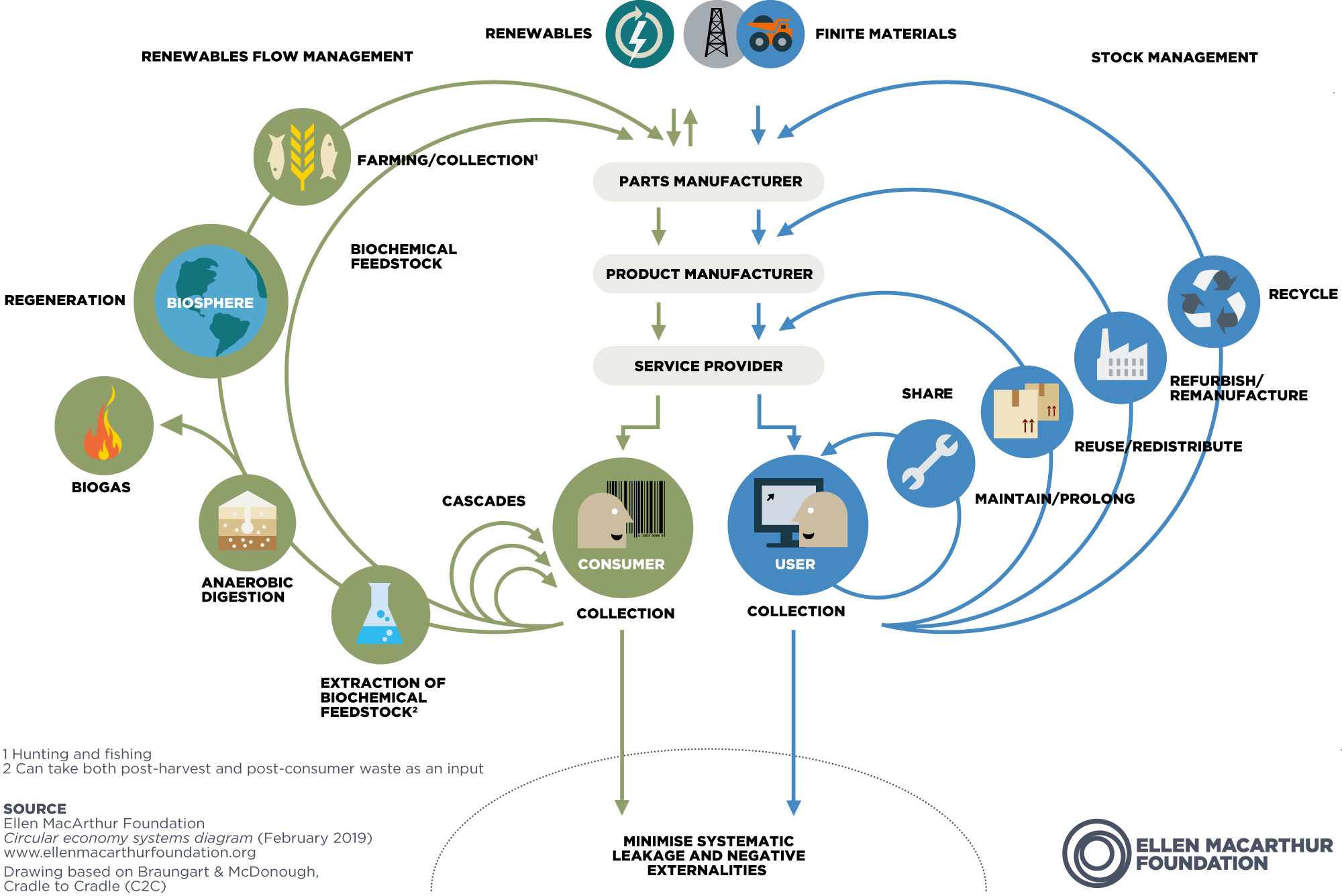
 Circular Economy Butterfly Chart by the Ellen MacArthur Foundation
The idea is to have something like a research institute mixed with an incubator and launchpad focused on "simbiotic outputs - inputs streams".
Ideally, it would be a place where people would help transform unutilized waste streams into inputs for other "industries".
There are many companies who already do this in some level.
When I was a consultant, one of my clients was a company that used sugar cane "wastes" to feed yeast that was then grown and baked to become food and feed supplements (Biorigin).
I thought this was genius. It also gave much higher margins than the sugar cane which was the original product.
Cargill also does this in the pectin business where fruit peels are transformed and become food additives such as texturizers.
There are many other examples of things that already happen. But there is so much room for making this more relevant!
If you want to find out more about this, I would highly recommend checking out the Ellen MacArthur foundation site. They talk a lot about Circular Economy and have some nice reports and videos
here.
When I was in college, I went to germany to study reverse logistics in TU-Berlin. It was only two months, but I learned how the system works. The governement has some agendas on specific developments and this cascades to who is studying it. The Post-Doc has a team of PhD students, that have a team of Master's students, which in turn have graduate students.
All this is carefully orchestrated in a way that the research can be "split into different portions". Each one has their role in making the big picture come to life. This was so smart I thought. It is a "top-down" approach.
In Brazil you come up with what you want to study and do a project and try to fit into something. This creates more rooms for creativity, but it is less effective if want you to tackle a specific problem.
Maybe the idea is to have both, with different structures.
The problem is, in Europe this is publicly funded, and relying on this in Brazil is at least naive. Of course there might be some portion of it that uses grants, amongst other things, but the business model cannot depend solemly on this.
I want to invert a bit the logic of how incubators/accelerators work. They usually search for co-horts and ideas and then curate it.
I was thinking of driving these companies out of a proven necessity.
A research institute does research that may specialize in basic research or may be oriented to applied research.
However, in Brazil there are no associations or research institutes like those in Germany such as: Fraunhofer, Max Planck, Leibniz and Helmholtz. There are some private research institutes, such as Dupont, IBM, and Vale and two public examples are Embrapa and CNPEM (Centro Nacional de Pesquisa em Energia e Materiais).
An incubator supports start-up organizations and it generally offers (1) a physical location; (2) business services; (3) marketing services; (4) technical services; (5) financial support (by linking the entrepreneur to sources of finance and investment); and (6) networking and information services.
For what I envision, it could have three different models (inspiration based on a talk with Julia).
-
Adapting Reactively: Example: Company A, B, C from the meat industry have to dispose of their wastes. We would be the hub to which they would turn to. We would find ways to re-use this in another industry that already exists or that doesn't exist (in Brazil) yet. Then we would join them or create a new company from this. This might be the main source of income to help support the rest.
-
Mitigating Proactive: We know many externalities that certain actitivites entail. We would create a roadmap of initiatives we would pursue and proactively show these solutions to current players or help create new companies.
-
Avoiding impact: This might envolve a more technological approach. The idea is to "foresee" what kind of simbiosis can happen amongts new technologies (biotechnology, material science, energy, etc.) and substitute the harmful externalities that their counterparts might have. Example: Mushroom or seaweed protein instead of red meat.
The vision
"There's a project I'm working on with a group. And I think I've figured out a way to do it better, faster, cheaper. So I'm going to be like a hawk. I'm about to swoop in. I'm not going to be a vulture. A vulture waits until things fall apart, then comes in with a solution. But I'm not waiting. I'm gonna swoop. Like a hawk. A hawk grabs the rat while it's still alive"
I think this phrase summarises so much of what are big corporations. I've dealt so much with vultures and when I try to be a hawk, I get very discouraged.
I don't want to be a trampoline for the "priviledged" like accelerators are where only 2% of cohorts make it (only the best ones who have already reached a certain point). There is deffinetely merit in it. I just want to tackle it another way.
I want to help solve the problem and be the start for the best ones, not necessarily the final step for independence. Independent of social/economical backgrounds. How many of these start-ups that actually generate revenue have underpriledged people leading them?
This is a major shift. Almost all I have seen envolves having "cohort" submissions, from academic grants to accelerator challenges.
It is a long-term process but we want to improve upon the current mindset. We have to nurture the younger generations to love sinergies and apply them in all the new industries and companies that will emerge from this.
-
We will help develop a team that will tackle many of these challenges and then "pass it on".
-
We want people who find their "flow" in these situations.
-
We don't want to be a "money" investor or the "final stage launchpad".
-
We want to be the knowledge-to-application hub.
We want to have a community of people that range from the "subject-matter" experts to the young apprentice who still didn't even go to college, but who can be guided into technical jobs and eventually can even go to the "right" college once they've found their passions.
They will drive the change. Imagine how many brilliant people we don't promote because we can't see them? We are just scrapping the surface with those who already made it!
This is a hard question with no right answer. I really need as much help as I can get to drive this part. I will obviously need a lot of partners, critics, enthusiasts and skeptics to get there (or somewhere around there).
So the first step was creating this website.
Then, I want to spread the word. I want to talk to everyone who might help make this take shape. I need all the criticism I can get.
I want to get into the research and teaching community as well. Not only to be more consistent, but also because I really like teaching. It gives me a lot of satisfaction.
I also want to start learning about artificial intelligence and how this can be applied to the simbiotic relationships out there. There is so much information that we might not see! And so many people connections we miss out on.
I got tired just spitting thi all out, so I figure I will need a place to recharge my energy and brain and reconnect to the reasons why. So I will put that in the plans as well.
Eventually, I might meet the right partners. Those who share a similar vision to mine and who want to partake in this (I will probably meet the wrong partners along the way as well!).
Then I will probably be old, but will have enjoyed the path to wherever I end up!


 Português
 English